The Quadrilatero, Bologna: A Guide to the Medieval Market District
Your guide to the Quadrilatero — Bologna's medieval market quarter: the historic delis, the markets compared honestly, a self-guided eating route and the aperitivo scene.
Step off the sunlit expanse of Piazza Maggiore, duck under the arches of the Palazzo dei Banchi, and within ten paces the city changes key. The light drops. The lanes narrow to the width of a market cart. And the smell hits you: cured pork fat and aged cheese, wet fish on crushed ice, warm bread, coffee, the sweet ferment of open wine bottles. This is the Quadrilatero — Bologna’s medieval market quarter, a grid of stone-flagged streets that has been trading, in more or less the same spot, since before the year 1000.
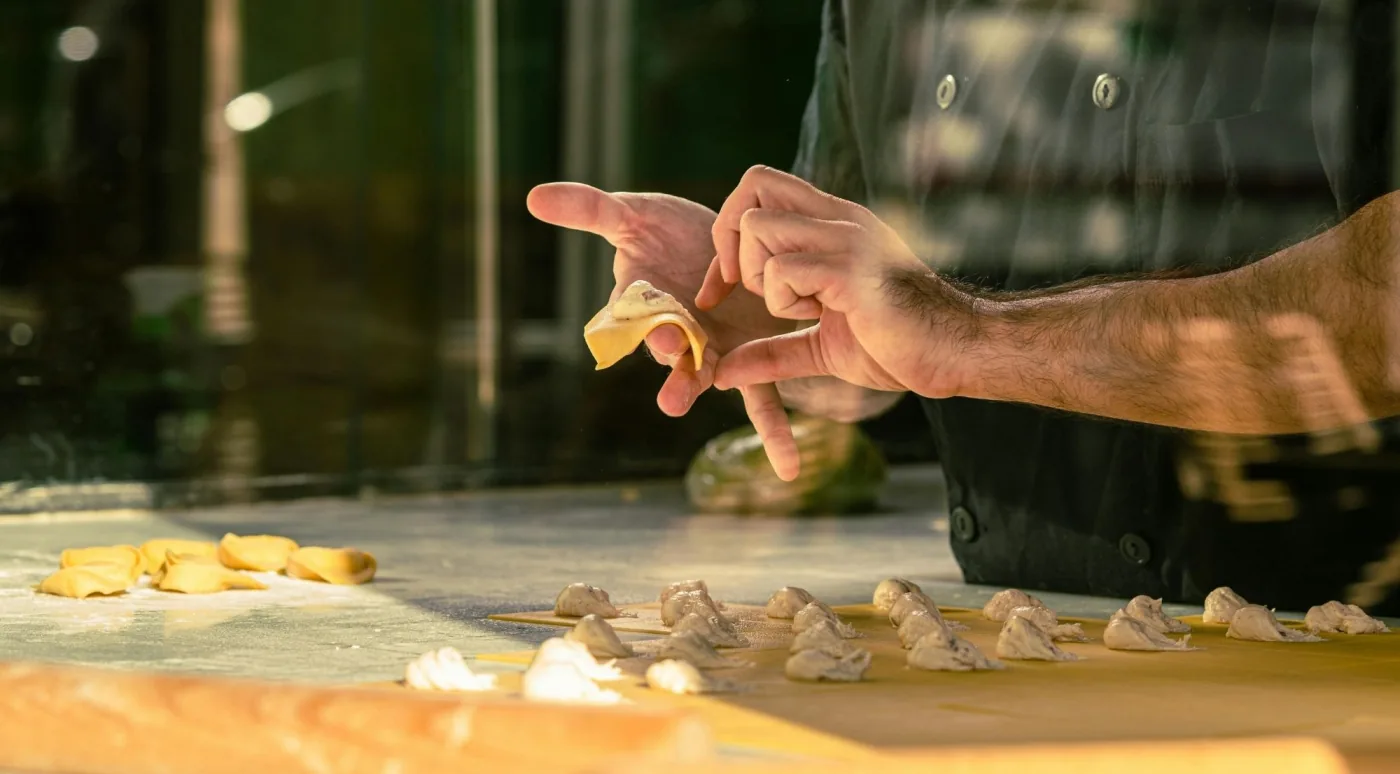
For anyone chasing a taste of Bologna on foot, this is ground zero. It is loud, aromatic, occasionally touristy — and, if you know how to read it, one of the great food experiences in Italy.
If you’d rather have the introductions made for you, the walking food tour below covers the Quadrilatero in its natural context — check live dates first.
What the Quadrilatero is and where to find it
The Quadrilatero (literally “quadrangle”) is a compact grid of lanes immediately south-east of Piazza Maggiore, roughly bounded by Via Rizzoli to the north, Via Castiglione to the east, Via Farini to the south and Via dell’Archiginnasio to the west. You can walk from one side to the other in five minutes — but you shouldn’t.
The street plan is genuinely ancient. Bologna began as the Roman colony of Bononia, laid out on the standard grid of cardo and decumanus. The Quadrilatero’s parallel lanes still shadow those two-thousand-year-old lines. A fragment of original basalt paving from Via Rizzoli, complete with cart ruts, was unearthed in 1959 and is preserved in the city’s history museum in Palazzo Pepoli.
In the Middle Ages this became the commercial heart of the city — the mercato di mezzo, the “middle market” — packed with workshops, banks and craft guilds. The trades sorted themselves street by street, and the names survive as a kind of edible archaeology:
- Via Pescherie Vecchie — the old fishmongers (the trade still partly present on its original street)
- Via Drapperie — drapers and cloth merchants
- Via Caprarie — goat-sellers and butchers
- Via Clavature — locksmiths and key-makers
- Via degli Orefici — goldsmiths (jewellers still trade here today)
- Via Calzolerie — shoemakers
- Vicolo Ranocchi — literally “Frog Alley,” where frogs were sold at market
- Via dei Vinazzieri — the wine sellers
Today the fabric shops and cobblers are gone, replaced by delis, pasta makers, cheesemongers, wine bars and a handful of luxury boutiques. But the market DNA is intact, and it is still, first and foremost, about food.
The Quadrilatero is the starting point, not the end. Bologna and Emilia-Romagna have far more to offer — Parmigiano Reggiano dairies in the countryside, traditional balsamic acetaie in Modena, Parma ham cellars in Langhirano, and wine estates in the Colli Bolognesi. If you want to connect what you buy in the Quadrilatero to the people and the landscapes that produced it, a full-day Food Valley tour handles the transport, the introductions and the long lunch. For pasta lovers, a hands-on cooking class with a local sfoglina is the ideal follow-up to a day spent tasting in the market lanes.
The historic shops and delis
This is a district of family businesses, some of them astonishingly old. Hours vary seasonally and closures happen with little notice — always check ahead before a dedicated trip.
| Shop | Address | Founded | Known for |
|---|---|---|---|
| Tamburini | Via Caprarie 1 | 1932 | Bologna’s landmark salumeria and tavola calda: mortadella, cotechino, fresh pasta, hot-food counter |
| Salumeria Simoni | Via Drapperie 5/2a | 1960 | The most respected deli in the quarter — take a number; mortadella sliced translucent, culatello, Parmigiano |
| Simoni Laboratorio | Via Pescherie Vecchie 3/b | — | Sit-down offshoot: boards of meats and cheese with a glass of wine |
| Paolo Atti & Figli | Via Drapperie 6 (bakery) / Via Caprarie 7 (pasta) | 1868 | Handmade tortellini and tagliatelle; traditional breads; certosino |
| Bruno e Franco – La Salumeria | Via Oberdan 16a | 1985 | A quieter local favourite for cured meats, fresh pasta and takeaway dishes |
| La Baita – Vecchia Malga | Via Pescherie Vecchie 3/a | — | One of the city’s best-known cheese shops, plus a trattoria |
| Pescheria Brunelli | Via Drapperie 8/a | 1924 | One of the last true fishmongers in the market; fresh Adriatic fish, mornings only |
| Antica Aguzzeria del Cavallo | Via Drapperie 12/b | 1783 | The oldest shop in Bologna: knives, blade-sharpening and arcane pasta tools |
| Majani | Via de’ Carbonesi 5 | 1796 | Italy’s oldest chocolatier: the Cremino Fiat (created 1911), Scorza, chocolate tortellini |
Tamburini is the anchor: Bologna’s most famous deli, doubling as a tavola calda where you eat traditional Bolognese dishes standing at the wall or perched on a stool.
Salumeria Simoni is where the cognoscenti queue for mortadella sliced carta velina — tissue-paper thin. Take a number from the dispenser by the door. A few doors away, Simoni Laboratorio lets you sit and eat the same products as a proper plate with wine.
Paolo Atti & Figli is a working food museum: founded 1868, still run by the same family across five generations, still turning out hundreds of kilos of traditional bread every day while the pasta shop across the street makes tortellini and tagliatelle by hand.
The Antica Aguzzeria del Cavallo at Via Drapperie 12/b, open since 1783, is the oldest shop in Bologna. It still sharpens knives and sells the arcane brass tools of Italian home cooking — a Parmigiano knife makes an excellent and very local souvenir.
For dessert, walk to Majani on Via de’ Carbonesi (in business since 1796) and try the layered Cremino Fiat, created in 1911. For gelato: Gelateria Gianni is the crowd-pleaser near the market; for the city’s most technically acclaimed cones, walk to Cremeria Santo Stefano on Via Santo Stefano or Cremeria Cavour on Piazza Cavour.
The markets, honestly compared
“Market” means several different things in central Bologna, and visitors routinely confuse them.
| Market | Address | When | Character |
|---|---|---|---|
| Quadrilatero (the open lanes) | Via Pescherie Vecchie / Via Drapperie area | Shops broadly Mon–Sat, mornings and late afternoons; many closed Sun | Historic street market of delis and specialist shops — buying, grazing, atmosphere |
| Mercato di Mezzo | Via Clavature 12 | Daily, roughly 9:00–midnight | Covered food hall inside the Quadrilatero, redeveloped 2014 — largely tourist-facing, open late |
| Mercato delle Erbe | Via Ugo Bassi 23–25 | Mon–Sat mornings; some evening hours; closed Sun | Bologna’s largest covered market — real produce by day, aperitivo destination in the evening |
| Mercato Ritrovato | Via Azzo Gardino 65 (Cineteca courtyard) | Sat 9:00–14:00; additional summer Mon evenings | Slow Food farmers’ market: seasonal, organic, farm-direct |
The crucial point: the Mercato di Mezzo sits inside the Quadrilatero, on Via Clavature, and the two names get used interchangeably. Since its 2014 redevelopment it has been a covered food hall — largely tourist-facing, open until late, convenient but not the most local experience.
For a genuine working market, walk five minutes west to the Mercato delle Erbe on Via Ugo Bassi — Bologna’s largest covered market, where mornings belong to fruit, veg, fish, cheese and fresh pasta, and evenings (when its bars open) belong to local aperitivo.
The Mercato Ritrovato, held in the Cineteca courtyard since 2008, is a proper farmers’ market where every stallholder sells only what they grow or make. Saturday mornings, with additional Monday-evening sessions in summer.
What to eat and buy
- Mortadella di Bologna — ask for it sliced carta velina, tissue-paper thin. The best salumerie will do this at the counter.
- Parmigiano Reggiano — sold at different ages; always ask to taste across 12, 24 and 36 months before you buy.
- Prosciutto and culatello — Parma ham and its rarer, more intense cousin from the Po valley mists.
- Squacquerone — a soft, tangy, spreadable fresh cheese; the natural partner for warm tigelle and gnocco fritto.
- Fresh pasta — tortellini and tagliatelle made that morning, rolled by hand. Buy for the evening; eat soon.
- Crescentine / tigelle and gnocco fritto — griddled flatbreads and fried dough, both best eaten hot and stuffed with cured meats.
- Pignoletto and Lambrusco — the local white (crisp, often frizzante) and sparkling red. Both are food wines, designed to be drunk at the table or standing at the counter.
How to shop at the counter without embarrassing yourself
- Take a number. Busy shops have a ticket dispenser by the door. Do not approach the counter without one.
- Order by weight in etti. An etto is 100 grams. Two etti of mortadella is a generous portion.
- Ask for a taste. Posso assaggiare? (“May I taste?”) is normal and expected at a serious cheese counter.
- Don’t touch the produce. Point and let the vendor pick.
- Have cash as backup. Most shops now take cards, but connectivity can be patchy in the narrow lanes.
The aperitivo and evening scene
By day the Quadrilatero is a shopping and eating district — busiest from 8:00 to 11:00 in the morning. From roughly 6:00 to 9:00pm the lanes fill with after-work drinkers. Order a Pignoletto frizzante, a Lambrusco, or a spritz; in most bars the drink comes with something to nibble.
Osteria del Sole — the 1465 wine-only tavern
Hidden behind an unmarked door on Vicolo Ranocchi 1/d, the Osteria del Sole has poured wine since 1465. The rule is simple: it sells only wine and beer — no food whatsoever. You buy provisions from the surrounding market shops, carry them in, and drink at communal tables. A glass of house wine costs around €3–4. Come with a spread of mortadella, cheese and bread and you have one of the most pleasurable — and cheapest — meals in Bologna. The Osteria trades Monday to Saturday, roughly 11:00–21:30, and is closed on Sundays.
A self-guided eating route (about 1.5–2 hours)
- Piazza Maggiore — enter the Quadrilatero via Via Pescherie Vecchie.
- La Baita – Vecchia Malga — buy a wedge of Parmigiano Reggiano across three ages and a tub of squacquerone.
- Pescheria Brunelli — look at the working fishmonger (mornings only).
- Salumeria Simoni — take a number; order mortadella sliced carta velina, plus culatello if they have it.
- Antica Aguzzeria del Cavallo — browse the pasta tools. Consider a Parmigiano knife.
- Paolo Atti & Figli — fresh bread, torta di riso, or certosino (the dense medieval Christmas cake).
- Tamburini — a standing lunch of tortellini from the hot-food counter, or tigelle to go with your board.
- Mercato di Mezzo — a glass of wine, a rest from the lanes, a breather.
- Osteria del Sole — assemble your provisions at a communal table. Bring your own food, buy your wine.
- A gelateria — Gelateria Gianni is nearby; for a higher-craft scoop try Cremeria Santo Stefano or Cremeria Cavour.
- Back to Piazza Maggiore — via the porticoes.
Practicalities
- Opening hours. Most shops trade Monday–Saturday. Many close Sundays; some close Thursday afternoons or Monday mornings. Verify before a special visit.
- The midday riposo. Some shops shut from roughly 13:00–15:30 and reopen in the late afternoon.
- August / Ferragosto. Family-run businesses close for summer holidays, sometimes for weeks. Check ahead.
- Best times. Early morning (8:00–11:00) for the working market; midday for a hot lunch at a tavola calda; 6:00–9:00pm for aperitivo.
- Crowds. Via Pescherie Vecchie is the most congested lane. Slip onto Via Drapperie or Via Caprarie for breathing room.
- Accessibility. The lanes are cobbled and uneven. The covered Mercato di Mezzo is easier for wheels.
- Photography. Ask before photographing a shopkeeper mid-slice — they are working, not performing.
- Pickpockets. Keep bags zipped during the aperitivo crush.
Guided tours of the Quadrilatero
Going with a guide buys you introductions to shopkeepers, access behind the counter, and curation you can’t easily replicate alone. A guided walking food tour covers the Quadrilatero in its natural context — you taste products where they’re made, meet fourth-generation proprietors, and leave understanding why this district matters. Reputable operators running food market tours and street food walks through the Quadrilatero include Taste Bologna, Delicious Bologna, Secret Food Tours, Eating Europe, Curious Appetite and Streaty.
The Bologna: Guided Food Markets Tour is a dedicated 2-hour walk through the city’s food markets with a local guide. And the Bologna: Street Food Tour in the Historic Center covers the neighbourhood’s most iconic bites — tigelle, stuffed crescentine, fried tortellini, mortadella and Parmigiano — in 2 hours, designed for travellers who want to eat like a local without a sit-down format.
Common mistakes
- Don’t order “spaghetti bolognese.” It does not exist in Bologna. The authentic dish is tagliatelle al ragù — order that.
- Know the difference between Mercato di Mezzo and Mercato delle Erbe. The first is a tourist-facing food hall open all day; the second is the real working market, closed Sundays.
- Beware viral queues. The genuine pleasure here is the counter experience — a proper ticket dispenser, a slicer in constant motion, a vendor who knows the product. Not a 45-minute queue for a photogenic sandwich.
- Understand the coperto. A cover charge of roughly €1–3 per person at a sit-down venue is legal, normal and not a scam.
- The Quadrilatero is not a produce market. It’s primarily a deli-and-aperitivo district. For everyday produce shopping, locals head to the Mercato delle Erbe.
- Know what “traditional balsamic” means. The cheap balsamic in the tourist shops and the DOP Aceto Balsamico Tradizionale di Modena are entirely different products. A good food tour will explain the difference.
For a wider guide to what to eat and why, including dishes, wines and the protected-product system, see what to eat in Bologna.
FAQ
What is the Quadrilatero in Bologna?
The medieval market district immediately south-east of Piazza Maggiore — a compact grid of narrow lanes on a Roman street plan, whose names still record the old trades. Today it is a dense cluster of historic delis, cheesemongers, fresh-pasta shops, bakeries and wine bars, and the closest thing Bologna has to a living museum of its food culture.
Is the Quadrilatero worth visiting?
Yes — it’s one of the essential things to do in Bologna. Parts of it have become touristy, but the family shops, the covered markets and the evening aperitivo scene remain genuinely Bolognese and are easy to enjoy if you shop and graze like a local.
Can I visit the Quadrilatero without a guide?
Yes, and the route in this article is enough to do it well — and our self-guided food walk extends it into a full day, from the morning cappuccino to the nightcap. But a guided walking food tour adds introductions and access that are difficult to replicate alone — vendors who recognise the guide, samples poured behind the counter, and the cultural context that turns a deli visit into something you’ll actually remember. If you have time for only one experience in Bologna, a tour is worth the extra step.
Taste Bologna Like a Local — One Unforgettable Walk
Join 1,870+ guests who rated this experience 4.8/5. Tortellini, mortadella, Parmigiano Reggiano, Lambrusco, and gelato — sampled across the historic centre with an expert local guide. Free cancellation.
Check Availability & Book